C D M O D I V I S I O N - S M A L L M O L E C U L E
From Process Development
to Commercial Supply
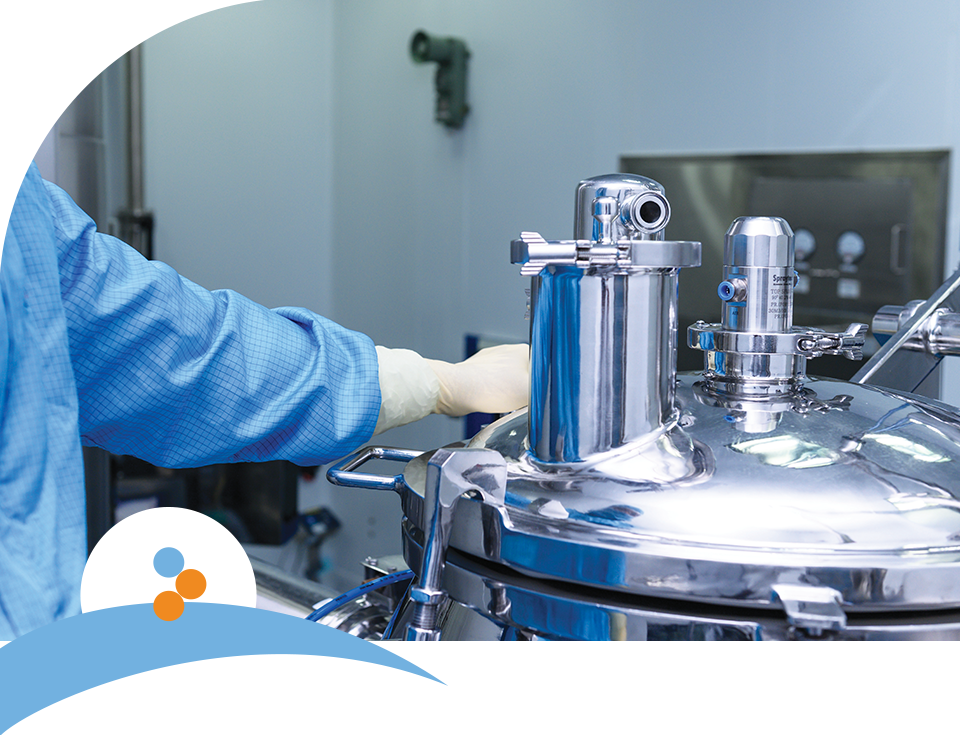
A new commercial-scale facility for liquid-filled hard gelatin capsules strengthened our oral solid dosage platform, while progress across chemical development, formulations and manufacturing operations further broadened our small molecule offering.
Chemical Development
Chemical Development expanded its contribution to our small molecule CDMO offering through stronger delivery performance, broader scientific application and growing relevance across both core chemistry and newer modalities. Higher customer satisfaction and improved delivery metrics also pointed to better execution and deeper engagement with customers, including new relationships that scaled quickly.
Scientific work covered a wide range of chemistries and development needs. In addition to continued delivery in core areas such as metal-catalyzed reactions and multistep development and manufacturing, the team advanced work in peptides, oligonucleotides and biocatalysis. Proof of concept was also established in photoredox, electrochemistry and flow chemistry, helping extend the technology base available for future customer programs.
Emphasis on process understanding and development quality continued. Approaches such as design of experiments and quality by design were used to improve robustness in selected programs, while sharper technology transfer practices supported more reliable scale-up and plant execution. This helped strengthen continuity between laboratory development and manufacturing.
Formulations Development
Formulations Development continued to advance our small molecule CDMO offering by broadening capabilities across complex dosage forms and improving the transition from development to manufacturing.
Progress during the year reflected a focus on technical reliability, regulatory-readiness and integrated support across oral and injectable dosage forms. Key developments included successful first-time-right technology transfer of liquid-filled hard gelatin capsule formats and formulation-led work on modified-release approaches to support product optimization. The platform’s external credibility was further reinforced, with U.S. FDA approval received for an oral solid dosage product supported by our formulation and manufacturing network.
Capability building during the year included the commissioning of a new commercial-scale facility for liquid-filled hard gelatin capsules, enabling the development and manufacture of complex, hard-to-dissolve medicines with greater precision and reliability. Added solid-state characterization capabilities and selected fill-finish enhancements for small molecules and biologics drug product further improved flexibility and delivery.
Analytical Development
The analytical services portfolio has been significantly strengthened, evolving beyond traditional testing to deliver end-to-end lifecycle support, operational excellence and digital enablement.
The service line was expanded to include reference standard qualification, lifecycle management and CSU supplies, ensuring reliable availability of qualified standards and uninterrupted analytical execution. Stability services were enhanced to support aging studies for large-volume parenteral formulations, strengthening product lifecycle coverage.
To drive operational excellence, laboratories achieved 5S JUSE certification, resulting in improved workplace agility and faster turnaround times. In parallel, AI-based documentation initiatives were piloted to enhance accuracy, compliance and review efficiency.
A phase appropriate quality system has been implemented to enable speed and agility through harmonized, risk-based processes aligned to development stages, without compromising compliance. Analytical services were further scaled through expanded method validation, verification and transfer capabilities across development phases.
Capability and skill development initiatives have been strengthened through structured training programs focused on method verifications and validations, calibrations and critical technical competencies, building depth and resilience within teams. In parallel, managerial capability building has been enhanced through participation in QCFI certification, Aspire leadership programs, Black Belt certification, and other structured development initiatives, strengthening leadership effectiveness and operational maturity.
As part of the digital transformation roadmap, ELN scope enhancement is currently in progress to transition all stability analyses to paperless documentation. By June 2026, all stability analysis activities are planned to be fully executed within the ELN system, improving data integrity, traceability, review efficiency and compliance.
Capability building was further extended to raw material testing for GLP-1 programs and screening of mAb samples, enhancing readiness for high impact therapeutic areas. Additionally, digital tools such as Bio Pathfinder were introduced to enable rapid screening and characterization of oligonucleotide samples, supporting faster and more informed decision-making in complex modality analytics.
Collectively, these initiatives have transformed analytical services into a robust, future-ready platform, delivering faster execution, higher quality, digital enablement, and differentiated value to clients.
MSEZ Operations (Mangaluru)
MSEZ operations recorded steady progress across commercial execution, regulatory compliance, digitization and operational simplification within our small molecule manufacturing platform. Following the successful delivery of commercial intermediates and APIs, the site secured repeat business that has contributed to improved manufacturing capacity utilization. This year, the site successfully executed commercial and process performance qualification campaigns, further expanding its role in supporting customers across late-stage and commercial manufacturing requirements.
Driven by a culture of continuous improvement, the MSEZ team achieved significant milestones in operational efficiency and cost optimization this past year. Infrastructure upgrades, including new reactor capacity, have provided greater flexibility for smaller-scale projects, while the integration of automation controls in critical operations has strengthened process reliability.
Digitization efforts also marked a key milestone with the transition of paper-based workflows to electronic systems, notably through the implementation of electronic batch manufacturing records for technical and early-phase GMP batches. Furthermore, our focus on sustainable operations led to the successful deployment of a heat pump in the QC Microbiology lab, resulting in measurable energy savings. This proven technology is now being extended to the API cleanroom, reinforcing our commitment to eco-efficient manufacturing.
Simplification and phase-appropriate quality systems helped improve speed and efficiency, particularly for technical and early phase projects, while maintaining compliance. The year also marked a sustainability milestone, with the Mangaluru site becoming the first within our network to receive Platinum recognition under the Zero Waste to Landfill framework. Additionally, the MSEZ site is now supplied with Piped Natural Gas (PNG), eliminating the need for Liquefied Petroleum Gas (LPG) cylinders and diesel and improving on-site safety.